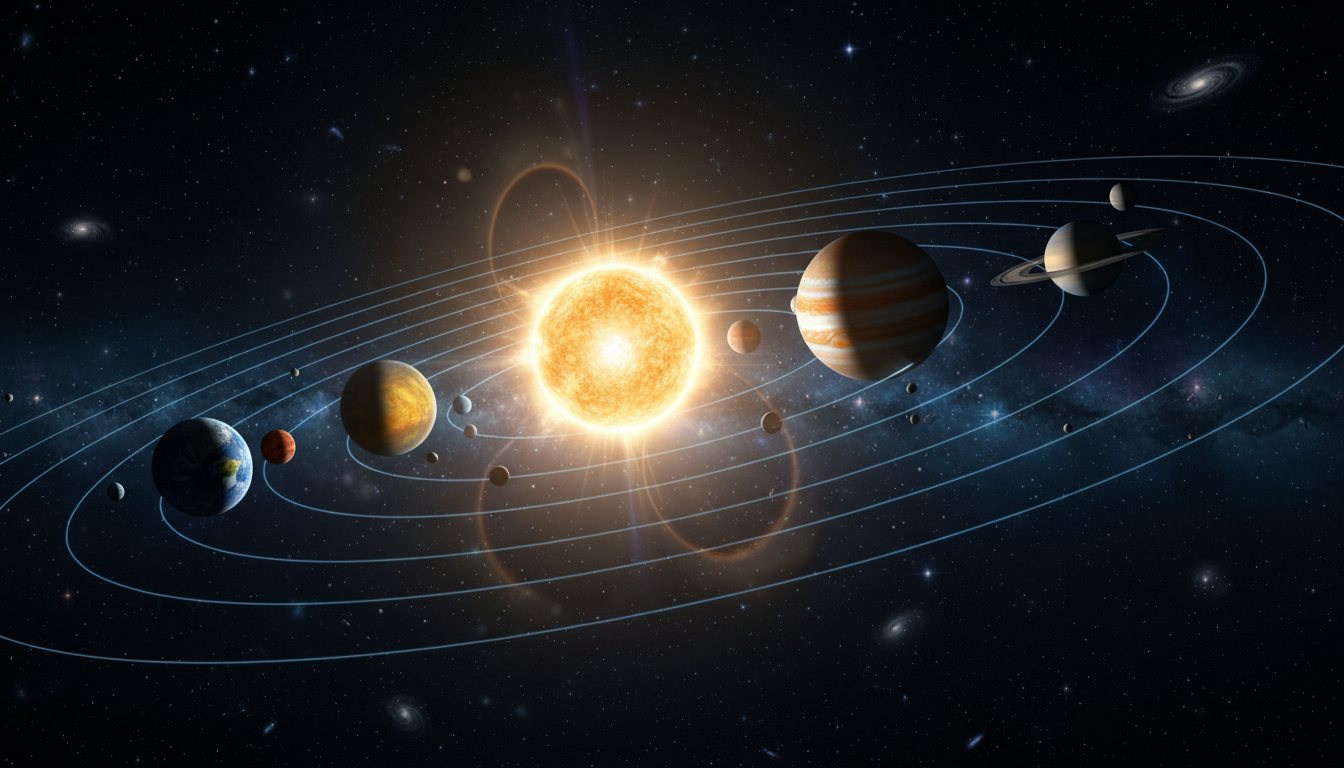
The Sun serves as the gravitational anchor of our corner of the Milky Way, a radiant star that governs a complex and fascinating neighborhood. Within its reach, a diverse collection of planets, moons, and debris dance in a perpetual orbital ballet, each telling a unique story of the universe’s history.
The Solar System Overview
The Solar System is a vast expanse dominated by the Sun, which contains more than 99.8% of the system’s total mass. This gravitational powerhouse keeps everything from the smallest dust grain to the largest planet in a stable orbit. The system is structured into distinct zones, beginning with the inner rocky planets, followed by the asteroid belt, and extending to the massive gas and ice giants. Beyond these lies the Kuiper Belt and the mysterious Oort Cloud, marking the outer limits of the Sun’s influence. This entire structure is encased within the heliosphere, a bubble of charged particles that protects us from the harsh interstellar medium. Understanding this layout is the first step in appreciating the delicate balance that allows life to thrive on our home planet.
Terrestrial Planets (Mercury, Venus, Earth, Mars)
Closest to the Sun lie the four terrestrial planets: Mercury, Venus, Earth, and Mars. These worlds are characterized by their solid, rocky surfaces and relatively small sizes. Mercury, the smallest and innermost planet, is a cratered world with extreme temperature swings. Venus, often called Earth’s twin in size, is shrouded in a thick, toxic atmosphere that creates a runaway greenhouse effect, making it the hottest planet in the system. Earth remains the only known haven for life, boasting vast liquid oceans and a protective atmosphere. Finally, Mars, the Red Planet, captivates scientists with its history of flowing water and its potential for future human exploration. These inner worlds represent the “inner circle” of our solar neighborhood, shaped by the intense heat and radiation of the nearby Sun.
Gas and Ice Giants (Jupiter, Saturn, Uranus, Neptune)
Beyond the asteroid belt, the scale of the Solar System shifts dramatically with the presence of the four giant planets. Jupiter and Saturn, the gas giants, are composed primarily of hydrogen and helium. Jupiter is the undisputed king of planets, possessing a Great Red Spot and a massive magnetic field, while Saturn is world-renowned for its spectacular and complex ring system. Further out, we encounter the ice giants, Uranus and Neptune. These planets are rich in “ices” like water, ammonia, and methane, which give them their distinct blue hues. Uranus is unique for its extreme axial tilt, essentially orbiting the Sun on its side, while Neptune is known for its supersonic winds and deep blue atmosphere. Together, these four giants hold the majority of the planetary mass in our system.
The Asteroid Belt
Situated between the orbits of Mars and Jupiter is the Asteroid Belt, a vast region populated by millions of rocky fragments left over from the early formation of the Solar System. Despite how they are often portrayed in science fiction, the belt is mostly empty space, with vast distances between individual objects. The largest inhabitant of this region is Ceres, a dwarf planet that contains about a third of the belt’s total mass. These asteroids are essentially “space fossils,” providing scientists with invaluable clues about the chemical composition and conditions of the protoplanetary disk from which the planets emerged. Gravitational tugs from Jupiter often prevent these fragments from coalescing into a single planet, keeping them in a state of perpetual, rocky suspension.
Comets and the Oort Cloud
At the very fringes of the Sun’s gravitational reach lie the comets and the mysterious Oort Cloud. Comets are often described as “dirty snowballs,” composed of frozen gases, rocks, and dust. When their orbits bring them close to the Sun, they heat up and release gases, creating the iconic glowing coma and tail. While many comets originate in the Kuiper Belt, long-period comets are thought to come from the Oort Cloud, a theoretical spherical shell of icy debris surrounding the Solar System. This distant reservoir may extend up to 100,000 astronomical units from the Sun, marking the boundary where the Sun’s influence finally gives way to the gravity of neighboring stars. These icy visitors are time capsules from the dawn of our solar neighborhood.
Dwarf Planets and Trans-Neptunian Objects
Beyond the orbit of Neptune lies a cold, dark region known as the Kuiper Belt, home to dwarf planets and Trans-Neptunian Objects (TNOs). Pluto, once considered the ninth planet, is the most famous member of this group, possessing a complex surface of nitrogen ice and mountains. Other notable dwarf planets include Eris, which is nearly as large as Pluto, and Haumea and Makemake. These objects are remnants of the early Solar System that were never incorporated into the major planets. The study of TNOs is a frontier of modern astronomy, as they reveal the dynamics of the outer solar system and the processes that shaped its current configuration. This icy frontier reminds us that our solar neighborhood is much larger and more populated than it appears at first glance.
From the sun-scorched surface of Mercury to the frozen reaches of the Oort Cloud, the cosmic objects around the Sun form a diverse and dynamic family. Each planet, moon, and asteroid plays a role in the complex gravitational symphony that has persisted for billions of years. As we continue to send probes and telescopes into the dark, our understanding of these celestial neighbors grows, revealing a Solar System that is far more intricate and awe-inspiring than we ever imagined.
Leave a Reply