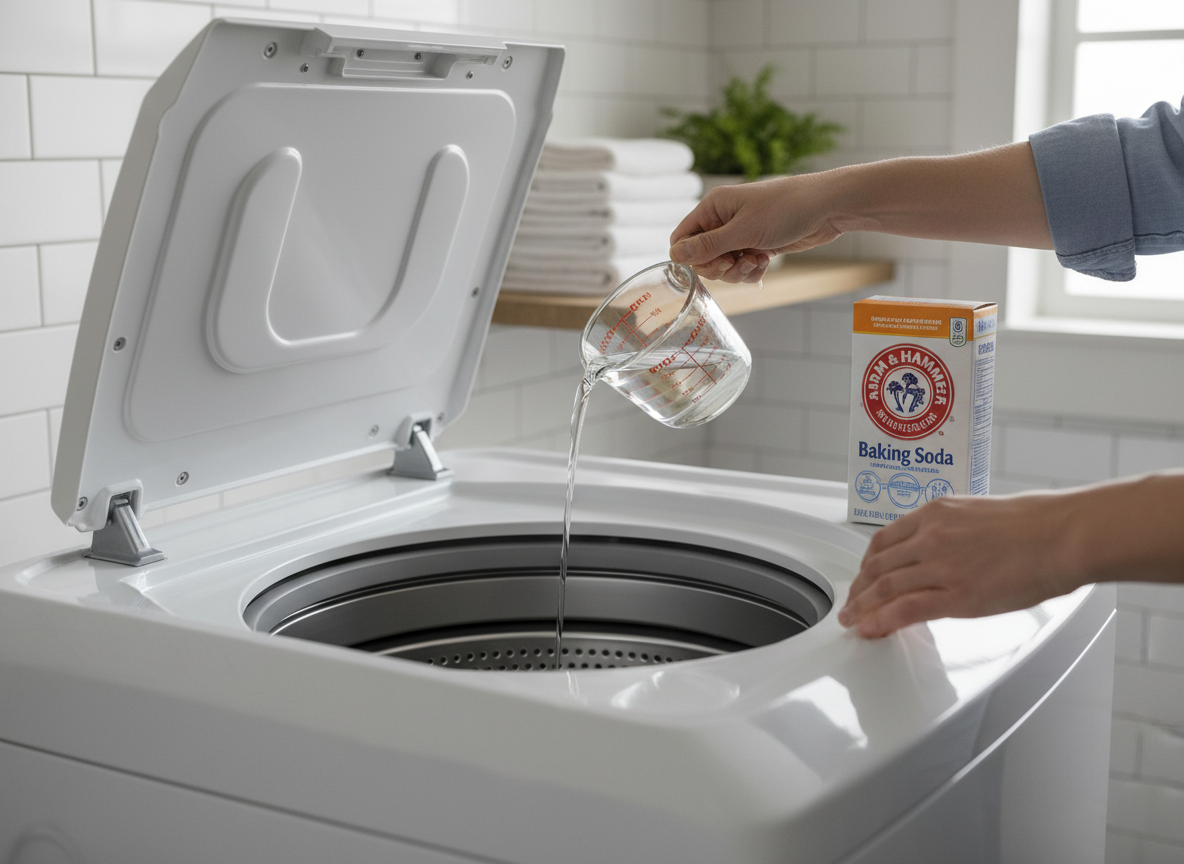
Top-loading washing machines are beloved for their convenience — you can toss in a forgotten sock mid-cycle, they’re easier on your back, and they tend to be less fussy about mold than front-loaders. But don’t let that fool you: a top-loading washer still needs regular deep cleaning. Without it, you’ll deal with detergent buildup, hard water deposits, bacterial growth in the drum, and eventually, that unmistakable musty smell on your supposedly clean clothes. This guide covers exactly how to clean a top-loading washing machine — including both agitator and high-efficiency (HE) impeller models — from drum to lid to dispensers.
This is a deep dive for top-loaders specifically. For a complete overview of washing machine cleaning covering all machine types and methods, see our complete washing machine cleaning guide.
Top-Loader vs Front-Loader: Key Differences for Cleaning
Top-loading washers don’t have a door gasket, which is the primary mold trap in front-loaders. That’s a significant advantage. However, top-loaders have their own problem areas:
- The drum rim and underside of the lid — water and detergent splash here and rarely get rinsed off
- The agitator (if present) — fabric softener collects in its dispenser and base, becoming a breeding ground for mold
- The drum walls above the waterline — the water level doesn’t reach the upper drum walls, leaving detergent residue to dry and accumulate
- The dispensers — liquid detergent and softener dispensers develop thick, waxy buildup
- The lid hinge and underside — frequently overlooked areas where grime collects
How Often to Clean a Top-Loading Washer
- Monthly: Full drum cleaning cycle
- Every 2–3 months: Deep clean the agitator, dispensers, drum walls, and lid
- Immediately: If clothes smell musty, you see residue on fabrics, or there’s any visible buildup
Supplies You’ll Need
- White distilled vinegar (4 cups for drum clean)
- Baking soda (½ cup)
- Washing machine cleaner tablet — optional
- Liquid chlorine bleach — optional, for sanitizing
- 2–3 microfiber cloths
- Old toothbrush or small scrub brush
- Rubber gloves
- Spray bottle
Step-by-Step: How to Deep Clean a Top-Loading Washer
Step 1: Run a Hot Water Cleaning Cycle
The first step is a hot cleaning cycle to loosen and flush out internal buildup from the drum, pump, and internal hoses.
- Make sure the drum is completely empty.
- Set your washer to the largest load size, hottest water temperature, and longest cycle available. This maximizes cleaning power.
- Add your chosen cleaning agent directly to the drum:
- 1 washing machine cleaner tablet (placed in the empty drum before starting), OR
- 1 cup (250 ml) of liquid chlorine bleach added to the drum, OR
- 4 cups (about 1 litre) of white distilled vinegar added to the drum
- Start the cycle.
- For the vinegar method: After the drum fills with water and agitates for about 1 minute, pause the cycle. Let the vinegar solution soak for 30–60 minutes. This extended soak dramatically improves cleaning effectiveness.
- Resume and let the cycle complete fully.
- Run an additional rinse and spin cycle to flush out any remaining cleaner residue.
Want to use the completely natural vinegar-and-baking-soda approach? See our dedicated guide on cleaning a washing machine with vinegar and baking soda for the full method and tips.
Step 2: Scrub the Drum Walls and Rim
After the cleaning cycle, the drum will be damp and the loosened residue easier to remove. Now do the hands-on scrubbing:
- Mix equal parts white vinegar and water in a spray bottle.
- Spray the inside walls of the drum thoroughly, paying special attention to the upper drum walls above where the water line reaches — this is where detergent residue and mineral deposits accumulate most.
- Wipe down the drum walls with a microfiber cloth, scrubbing any visible residue or staining.
- Wipe the drum rim (the top edge of the drum) — water and detergent splash up here on every wash.
- For stubborn mineral deposits or soap scum, apply undiluted vinegar and let it sit for 5 minutes before scrubbing with a brush.
Step 3: Clean the Agitator (Agitator Models Only)
If your top-loader has an agitator — the tall central post that twists back and forth to move clothes — it needs its own cleaning. The base and any fabric softener dispenser on top are prime mold spots.
- Check if your agitator has a fabric softener dispenser cap on top. If so, twist it counter-clockwise to remove it.
- Look inside the agitator post — you may find dark, waxy buildup and mold.
- Prepare a cleaning solution: 1 gallon of warm water, ¼ cup of liquid laundry detergent, and ½ cup of white vinegar (or bleach for severe mold — not both).
- Use a bottle brush or long-handled brush to scrub inside the agitator column.
- Soak the softener dispenser cap in the cleaning solution for 10–15 minutes.
- Scrub the cap with a toothbrush, rinse thoroughly, and replace it.
- Wipe down the outside surfaces of the agitator from top to bottom.
Step 4: Clean the Detergent and Fabric Softener Dispensers
Many top-loaders have dispensers built into the drum rim or lid. These accumulate concentrated detergent and softener residue:
- If the dispensers are removable, take them out. Check your manual for how to release them.
- Soak removable dispensers in warm water with white vinegar for 15 minutes.
- Scrub with a toothbrush to remove all buildup.
- Rinse thoroughly and replace.
- For fixed dispensers, use a cloth or toothbrush dipped in vinegar to scrub as deep into the dispenser as you can reach.
- Run the tap or pour water into the dispenser to flush out loosened residue.
Step 5: Clean the Lid, Hinges, and Exterior
- Open the lid and spray the underside with the vinegar-water solution.
- Wipe down the underside of the lid and the inner edge of the lid opening — this area collects dried detergent splashes and water stains.
- Clean the lid hinge area with a toothbrush to dislodge any accumulated grime.
- Close the lid and clean the exterior surfaces: top panel, front, sides, and back (as far as you can reach).
- Wipe the control panel with a slightly damp cloth — avoid getting moisture into buttons and knobs.
- After cleaning, leave the lid open to allow the drum to air dry completely.
Special Instructions for HE Top-Loaders (Impeller Models)
High-efficiency top-loaders (also called impeller or agitatorless models) use a low-profile impeller plate at the bottom of the drum instead of a central agitator. They use significantly less water than traditional top-loaders — and because of that, they’re actually more prone to detergent buildup than traditional top-loaders, since there’s less water to rinse residue away.
Key differences for HE top-loader cleaning:
- Use HE detergent exclusively. Regular detergent in an HE machine creates excessive suds that don’t rinse out properly, leaving residue in every wash.
- Reduce detergent dose. Even with HE detergent, many people use too much. Use the minimum recommended dose — often less than the cap’s lowest fill line.
- Clean the impeller plate. The impeller plate at the drum bottom needs scrubbing — mold can grow underneath it. Lift it if it’s removable (check your manual) or scrub around its edges with a toothbrush.
- Run dedicated cleaning cycles more frequently — monthly or after every 30 loads for HE models, since detergent residue builds faster.
Dealing with Stubborn Stains and Buildup
For machines with significant buildup from months or years of neglect, a single cleaning cycle may not be enough. Here’s a more aggressive approach:
- Two consecutive cleaning cycles — the first loosens buildup, the second flushes it out
- Soak-and-pause method — fill with the hottest water, add vinegar, and let it soak for 4–8 hours (or overnight) before completing the cycle
- Baking soda scrub — sprinkle baking soda directly on stubborn stains or mineral deposits inside the drum and scrub with a damp cloth before running a rinse cycle
- Bleach sanitize cycle — for bacterial contamination, 1 cup of bleach in the hottest cycle is more effective than vinegar at killing bacteria and mold spores
Prevention: Keep Your Top-Loader Clean Longer
- Leave the lid open after every wash. Unlike front-loaders, the open top-loader lid is less obtrusive — there’s really no reason not to do this.
- Use the correct detergent type — HE detergent for HE machines, standard for traditional agitator models.
- Measure detergent precisely. Excess detergent is the single biggest cause of drum buildup in top-loaders.
- Remove wet laundry promptly. Don’t leave damp clothes in the drum for more than 30 minutes after the cycle ends.
- Run a monthly maintenance clean — one tablet or cup of vinegar in an empty hot cycle keeps buildup from accumulating.
- Check pockets before washing. Coins, tissues, and small items can damage the machine and clog internal components.
Frequently Asked Questions
Do top-loading washing machines get mold?
Yes, though less commonly than front-loaders. Top-loaders can develop mold inside the agitator column, under the drum rim, around dispenser areas, and under the lid hinge. The open design and gravity drainage mean they dry out more readily than front-loaders, but without regular cleaning, mold can still take hold — especially in warm, humid climates.
How much vinegar do I use to clean a top-loading washer?
For a standard top-loader cleaning cycle, add 4 cups (about 1 litre) of white distilled vinegar directly to the drum. For HE top-loaders that use less water, 2 cups is sufficient. Always use white distilled vinegar — not apple cider vinegar or other types, which can leave residue and stains.
Can I use bleach in a top-loading washing machine?
Yes — liquid chlorine bleach is safe for most top-loading machines and very effective at sanitizing the drum. Add 1 cup directly to the drum (not the dispenser) before running a hot cycle. Never combine bleach with vinegar — the combination is toxic and ineffective. Check your machine’s manual if you’re unsure.
Why do my clothes smell after washing in a top-loader?
If your freshly washed clothes smell musty or sour, it usually means the drum has significant bacterial buildup. This is most common when: too much detergent is used (leaves residue that feeds bacteria), the machine is used only for cold washes (bacteria survive in cold water), or laundry is left sitting in the drum after the cycle ends. Start with a hot vinegar cleaning cycle and make sure you’re using the correct type and amount of detergent.
Conclusion
Cleaning a top-loading washing machine is straightforward: a monthly hot cycle with a cleaning agent handles most of the internal maintenance, and a quarterly deep clean of the drum walls, agitator, dispensers, and lid keeps every component in top condition. The most important habits — leaving the lid open, using the right amount of HE detergent, and removing laundry promptly — will dramatically reduce how often you need a full deep clean.
For a comprehensive guide covering both front-loading and top-loading machines, plus all the best cleaning methods and supplies, see our main guide: How to Clean a Washing Machine: The Complete Step-by-Step Guide.
Leave a Reply