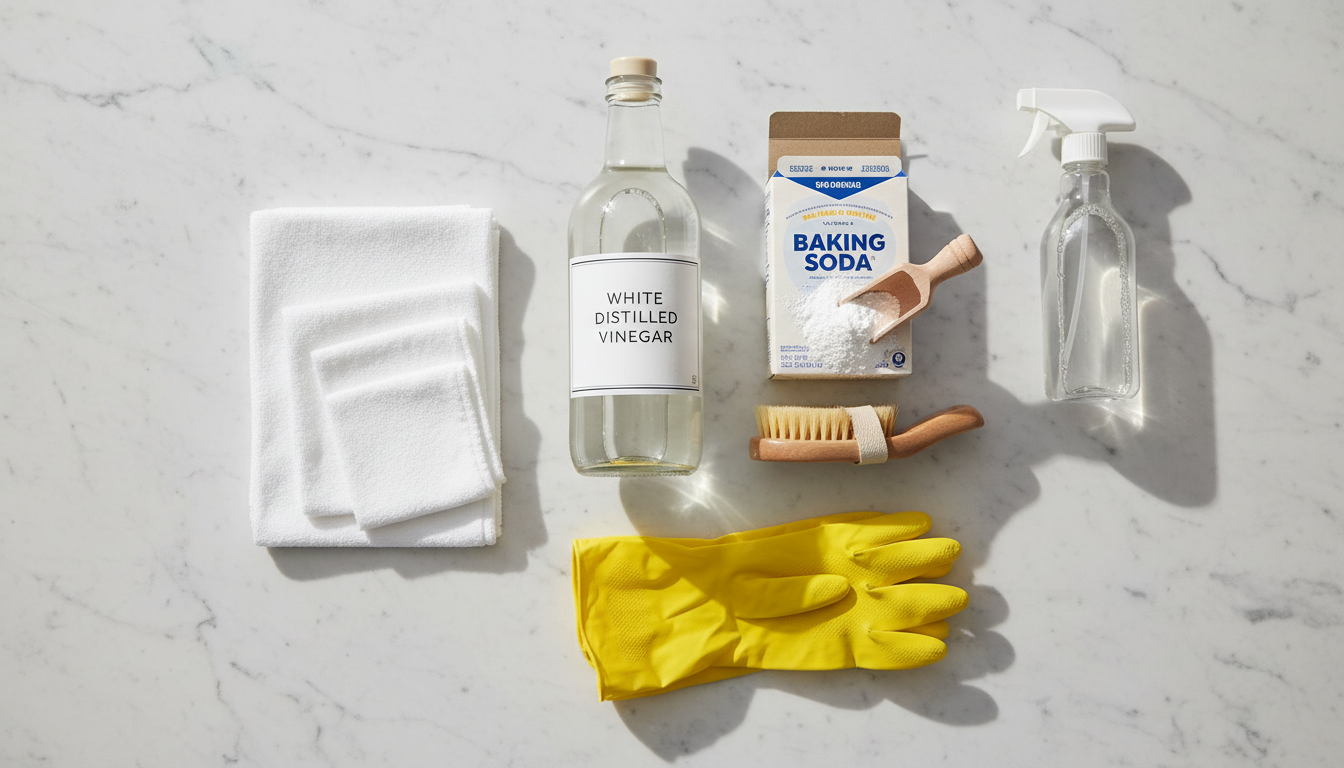
You don’t need expensive commercial cleaners or harsh chemicals to keep your washing machine spotless. Cleaning a washing machine with vinegar and baking soda is one of the most effective, affordable, and eco-friendly methods available — and it works on both front-loading and top-loading machines. Two pantry staples that cost less than a dollar per cleaning can dissolve detergent residue, neutralize odors, and inhibit mold growth just as well as commercial tablets for routine maintenance. Here’s the complete guide.
This guide focuses specifically on the natural vinegar-and-baking-soda method. For a complete overview of all washing machine cleaning methods and a full maintenance guide, see our complete guide to cleaning a washing machine.
Why Vinegar and Baking Soda Work
White distilled vinegar is a mild acid (about 5% acetic acid) that is remarkably effective at dissolving mineral deposits, cutting through soap scum and detergent residue, and killing a wide range of bacteria and mold species. The EPA has confirmed that vinegar kills approximately 82% of common household mold species. It also neutralizes alkaline odors — which is why it’s so effective at eliminating the musty smell that builds up in washing machine drums.
Baking soda (sodium bicarbonate) is a mild alkali and a powerful deodorizer. It neutralizes acidic odors (the kind produced by bacteria), provides gentle abrasive action when scrubbing, and helps loosen and absorb residue from surfaces. It also brightens and softens the drum in a way that vinegar alone doesn’t achieve.
Why You Should NOT Mix Them Together
This is the most important thing to understand about using vinegar and baking soda for washing machine cleaning: do not mix them in the same cycle.
When acid (vinegar) meets alkali (baking soda), they undergo an acid-base neutralization reaction, producing water, CO₂ (that satisfying fizz), and sodium acetate. The reaction largely cancels out the individual cleaning properties of both substances. You get foam, not cleaning power.
Use them in separate, consecutive cycles: vinegar first (descaling and mold-killing cycle), then baking soda second (deodorizing and polishing cycle). This way, each substance works at full strength.
What You Need
- White distilled vinegar — 2 cups for front-loaders, 4 cups for top-loaders
- Baking soda — ½ cup
- Microfiber cloths (2–3)
- Small scrub brush or old toothbrush
- Rubber gloves
- Spray bottle (optional but useful)
Important: Always use white distilled vinegar, not apple cider vinegar or wine vinegar. Other types contain tannins and sugars that can leave stains and residue in your machine.
How to Clean a Front-Loading Washer with Vinegar and Baking Soda
Cycle 1: Vinegar (Deep Clean and Mold Kill)
- Make sure the drum is completely empty — no clothing or items.
- Pour 2 cups of white distilled vinegar into the detergent dispenser drawer.
- Select the hottest available cycle — “Clean Washer,” “Sanitize,” or simply the longest, hottest wash setting your machine has.
- Run the complete cycle. The vinegar will be dispensed at the correct point in the cycle and will circulate through the drum and all internal components.
Cycle 2: Baking Soda (Deodorize and Freshen)
- Once the vinegar cycle has completed, add ½ cup of baking soda directly into the drum (not the dispenser).
- Run another short hot cycle — even just the shortest hot wash your machine has will work.
- After this cycle completes, wipe down the drum interior, door glass, and the inside of the door seal with a clean microfiber cloth to remove any residue that was loosened by the cleaning cycles.
- Leave the door ajar for at least 1–2 hours to allow the interior to dry completely.
Between Cycles: Manual Cleaning
While the vinegar cycle is running, take the opportunity to clean the components that the cycle doesn’t fully reach:
- Gasket: Dip a toothbrush in undiluted white vinegar and scrub all the folds of the rubber door seal. Wipe clean with a damp cloth. For heavy mold, see our article on how to remove mold from a washing machine.
- Detergent drawer: Remove the drawer while the cycle runs. Soak it in a mix of hot water and vinegar for 15 minutes, scrub, and rinse.
- Door glass: Wipe with a cloth dampened in undiluted vinegar for a streak-free clean.
How to Clean a Top-Loading Washer with Vinegar and Baking Soda
The top-loader method takes advantage of the machine’s open design to allow an extended soak — which significantly improves cleaning effectiveness:
Stage 1: Vinegar Soak Cycle
- Set the machine to the largest load size, hottest temperature, and longest cycle.
- Start the machine and let it fill completely with hot water.
- Once full, add 4 cups of white distilled vinegar directly into the water in the drum.
- Let the machine agitate for 1–2 minutes to mix the vinegar throughout the water.
- Pause the cycle. Let the vinegar solution soak for 30–60 minutes. For a machine that hasn’t been cleaned in a long time, a 2-hour soak is even more effective.
- While soaking, use a cloth dipped in the vinegar wash water to wipe down the lid underside, drum rim, and any accessible dispensers. The hot vinegar solution is at its most effective right now.
- Resume the cycle and let it run to completion.
- Run an additional rinse cycle.
Stage 2: Baking Soda Cycle
- Start a new hot wash cycle at the largest load size.
- Once the drum fills with water, add ½ cup of baking soda directly into the water.
- Let the machine agitate for 1 minute, then pause for 15–30 minutes to allow the baking soda to deodorize and work on remaining residue.
- Resume and complete the cycle.
- After the cycle, wipe down the drum interior, drum walls, and drum rim with a dry cloth.
- Leave the lid open to allow complete drying.
Vinegar for Specific Problem Areas
Beyond the drum cleaning cycle, vinegar is useful for targeted cleaning of specific components:
Detergent Drawer
Fill a basin with equal parts hot water and white vinegar. Remove the drawer and soak for 20–30 minutes — the vinegar dissolves fabric softener buildup and detergent scale far more effectively than water alone. Scrub with a toothbrush and rinse clean.
Door Gasket (Front-Loaders)
Apply undiluted white vinegar directly to a cloth or toothbrush and scrub the gasket folds thoroughly. Let the vinegar sit for 5–10 minutes before wiping — this contact time is important for mold killing. For persistent black mold in the gasket, a bleach solution is more effective than vinegar (see our mold removal guide for details).
Exterior Surfaces
Mix equal parts vinegar and water in a spray bottle. Use this solution to clean the exterior panels, top, and control panel. It leaves a streak-free finish and removes water marks and detergent splashes effectively.
Drain Filter (Front-Loaders)
After removing the drain filter, soak it in undiluted white vinegar for 15–30 minutes to dissolve mineral scale and biofilm. Scrub with a brush and rinse. For the full filter cleaning process, see our complete guide on how to clean a washing machine filter.
Vinegar vs Commercial Washing Machine Cleaners
Here’s an honest comparison to help you choose the right cleaning approach:
| Factor | White Vinegar | Commercial Cleaner (Affresh, etc.) |
|---|---|---|
| Cost per use | ~$0.10–$0.20 | ~$2–$5 |
| Mold killing | Good (82% of species) | Good to excellent |
| Odor elimination | Excellent | Excellent |
| Descaling | Excellent | Good |
| Deep residue removal | Good | Excellent (engineered formula) |
| Eco-friendly | ✅ Yes | ❌ Chemical surfactants |
| Safe for all machines | ✅ Yes | Check model compatibility |
Recommendation: For regular monthly maintenance, white vinegar and baking soda are fully sufficient. For machines with heavy buildup from infrequent cleaning, or for an initial deep clean, a commercial cleaner tablet provides stronger action on thick residue. Many people alternate: vinegar for regular monthly cleans, commercial tablet for a quarterly deep clean.
How Often to Use This Method
- Monthly: Run the vinegar cycle alone as a quick maintenance clean
- Every 2–3 months: Full two-cycle method (vinegar + baking soda) plus manual component cleaning
- Immediately: If you notice odors, buildup on clothes, or visible mold starting to develop
Frequently Asked Questions
Will vinegar damage my washing machine?
Used correctly, white distilled vinegar is safe for washing machine drums, rubber seals, and plastic components. Some appliance manufacturers caution against regular vinegar use due to its acidity affecting rubber seals over time — but at 5% concentration, the risk is minimal with monthly use. The greater risk comes from using undiluted vinegar directly on rubber seals repeatedly over years. For the drum cleaning cycle, the dilution in water makes it entirely safe. Check your machine’s manual if you’re uncertain about your specific model.
How much vinegar do I need to clean a washing machine?
For front-loaders: 2 cups (about 500ml) in the detergent dispenser for a drum cleaning cycle. For top-loaders: 4 cups (about 1 litre) added directly to the drum once filled with hot water. Use white distilled vinegar only — not other types.
Can I add vinegar to every wash cycle?
Some people add ¼ cup of white vinegar to the rinse cycle as a natural fabric softener and to prevent residue buildup. This is generally safe in moderation. However, for a proper cleaning cycle, running an empty hot cycle with vinegar is far more effective than adding it to regular wash loads.
Does baking soda clean a washing machine on its own?
Baking soda is primarily a deodorizer and mild abrasive — it’s excellent at neutralizing odors and providing gentle scrubbing action, but it’s less effective at killing mold or dissolving mineral scale than vinegar. It works best as a follow-up to a vinegar cycle, not as a standalone cleaning agent.
Conclusion
Cleaning your washing machine with vinegar and baking soda is simple, cheap, and remarkably effective for regular maintenance. The key is using them in separate cycles (never together), using the right quantities, and combining the drum cycles with manual cleaning of the gasket, drawer, and drum surfaces. Do this monthly and your machine will stay fresh, clean, and free of buildup indefinitely.
For the full picture — including how to handle front-loading and top-loading machines, clean every component, and deal with severe odors — visit our comprehensive guide: How to Clean a Washing Machine: The Complete Step-by-Step Guide.
Leave a Reply